Sunday, 22 June 2014

Week 39: one day flyaway and an International test

As I previously alluded, the weather has caused havoc with our flying schedule and as a consequence we are quite a few flights behind, and with only 7 weeks to go contingency plans are being put into effect to help us catch up. I was scheduled every day this week to try and get through my flight, but the weather continuously ruined my chances. As a result Scott, Liam and myself were given an aircraft for the day to try and get a few flights done, so we planned a three sector route around the east of the North Island. I personally think it looks like sonic the hedgehogs side profile...


As I was further behind I flew two of the three sectors, firstly down to Gisborne via Whatakane, Liam then flew us to Taupo via Napier, and finally I zig zagged across the plateau back to Hamilton via Rotorua. During the first flight, with the leg being quite long I decided to climb into controlled airspace in an attempt to avoid the turbulent air flowing over the ranges. To some extent this plan worked and the aircraft was very stable, but at the higher level the wind was slightly different to that forecast so I ended up with a slight track error; can't win them all! The landing at Whakatane was fairly uneventful, and after a touch and go I set course for Gisborne.

The leg to Gisborne was however a lot busier, as it was on this part of the route I was required to fly a diversion as this was a key part of the lesson. The main issue with flying a diversion is that you have to plan the route you'll be flying with a fair amount of accuracy, whilst flying the aircraft and communicating as normal. Put simply a diversion will follow the following structure:-
  • Decide to fly the diversion, where it will start and where its to
  • Draw a line (freehand) and the chart linking these points
  • Estimate the true track direction utilising the lat/long lines on the chart
  • Apply the Variation (ie the magnetic and geographic north poles aren't at the same spot)
  • Work out the drift on that track, and work out the heading to maintain track
  • Turn onto track at the predetermined point, adjusting altitude if necessary
  • Once the aircraft is established, start working out the timing to estimate an ETA
  • Find a point on the track which will act as an Event cycle feature
You can see from the above this can be quite involved, especially considering you're flying the aircraft and want to maintain all scans so the aircraft remains safe. After Liam had flown us across to Taupo I jumped in the front and flew the third sector. On the first leg we had quite a thick layer of cloud blocking our route over some high ground, so rather than fly underneath and risk getting trapped, I had my first opportunity to fly a 'hazard avoid'. We effectively turned the aircraft 60 degrees off track, flew for a few minutes to go around the cloud, paralled our track, then turned 60 degrees back towards our track to regain. So tomorrow i'm flying a route up north, and there's a possibility ill get to practice an emergency descent.


This weekend was the third test between England and the All Blacks, and as the match was in Hamilton seemingly half of CTC had turned up to the game. Unfortunately the All Blacks showed their class and ripped England apart in the first few minutes, but I can happily say i've ticked something off the bucket list and seen the Haka performed. As well as this I managed to get a sneaky picture in the coaches room, as well as meeting the Sky Sports pundit Stuart Barnes.


And finally, easyJet this week made an application to join a group who meet to discuss the expansion plans of Heathrow. This demonstrates the airline have a vested interest in the plans for a third runway, and if Heathrow is picked instead of Gatwick, easyJet will likely seek to gain slots so that they can eat further into the business traveller market. Anyway, I have planning to do so have a good week.

Sunday, 15 June 2014

Week 38: more navigation and PFL's

This week the bad weather has made a reappearance, with my first flight this week cancelled due to strong winds and low cloud. This was rescheduled for yesterday, and initially the plan was to report with another cadet and do three flights in a row with short breaks in between, with the possibility of travelling to other aerodromes. This is due to us now being 13 flights behind where we should be, and given we go home in 7 weeks on Thursday we need to average 5 flights a week just to get away on time. Unfortunately the three of us were actually so heavy we could only carry 26 gallons of fuel which was too little for the exercise, so the plan was scuppered!

Asides from the earlier frustration, my nav ex was relatively successful as the weather was good enough to route down to lake Taupo, where the volcanoes could be seen poking through the cloud layer. Below is the spider track trace which shows the route we took, and as you can see all the legs were straight so the actual wind matched what had been forecast. 


Hamilton, down to Kinloch, then up to Hinuera

Navigation with CTC is very particular, as the school has decided on a standardised method of managing the flight, from the way it's planned to the way it's flown. In terms of planning, the chart is marked with the route in the same manner as any other school. The difference is the use of a timing ladder as well as Event cycle features (the gaps on the route), which make adjusting timings and heading a lot easier. The Event cycle feature (ECF) should be a prominent feature on the route (town, mountain, lake etc), and as it's overflown (or not if the aircraft is moving off track) the pilot can decipher if the aircraft is on the planned track, and if the timing's will be correct. Obviously if the aircraft is going a lot slower, the route will take longer with increased fuel consumption as a consequence, with a really significant increase in headwind potentially requiring a diversion for fuel. 

CTC also employ 'HAT' checks, again to make sure the aircraft is flying according to the plan. There are pre-HAT and post-HAT checks, performed before and after a turn respectively. Hat stands for:-
  • Heading- what heading change is required at the turning point, is the aircraft on that heading after the turn?
  • Altitude- what is the planned altitude for the next leg, is a climb/descent required?
  • Time- reset the clock prior to the turn, start the timer over the turning point
This doesn't sound like much, but it gives a framework to start with, which helps when concentrating on flying the aircraft as well as the approaching turn. In addition to these HAT checks, periodic checks are performed at top of climb, in the cruise, and at top of descent, so there should never be an occasion when the pilot is just staring out the window. 

The observant among you will realise the aircraft was manoeuvring to the east of Hamilton prior to performing the arrival. This wasn't us lost and blindly picking a direction to go, it was the other part of the lesson 'Practice forced landings' (PFL's). Put very simply this is a simulation of an engine failure during flight, so the pilot is better equipped to deal with the situation if things go quiet. Mostly it's an exercise in judgement; if you are too low you don't have power to get you out of trouble, and if you are too high you may overshoot whichever site you've selected and may not have a safe area. I just pray that it never happens to me, and if it does i'm overhead an airfield because field selection is a nightmare!

I'm back in the aircraft tomorrow morning, this time with a diversion latched onto the end of my nav ex. This will involve marking the chart and planning the leg in flight, working out timings, all whilst keeping the aircraft flying safely, and continuing to lookout for other aircraft. I get the impression it's going to be a pretty busy flight!


Monday, 9 June 2014

Week 37: Navigation and an important visitor

Clearly for me the most significant and exciting event of the week was a visit from my girlfriend Alice, who had managed to wangle enough days off to make the trip out. We decided to hire a car to get around the North Island, but given it was so much more cost effective to collect it from Auckland airport, I found myself on a bus at 7am (with thanks to Dom for getting me to the station) on the way up to the airport. Fortunately I arrived with enough time to go up to Auckland's viewing deck, and watched the Qantas 737 land which was carrying Alice. Personally I think it's a shame the majority of airports don't have these viewing decks anymore, as it's almost taken some of the romance and excitement out of flying. 

Unfortunately following previous delays with our training I wasn't able to get leave to cover Alice's stay, so I was expecting a couple of events during the week. Annoyingly one of these ended up being a 5 hour briefing on visual navigation, but luckily for me my manager Troy did one of my sim flights before the brief so that I could have a collection of days off. The sim itself was quite interesting as Troy got me to perform a GPS flight from Hamilton to Roturua, with a procedural approach, go around and hold, all without outside reference. For the moment we will revert back to visual flight, but it's nice to have a better appreciation of navaids we can use to aid orientation during navigation.

Alice and I took the opportunity to use the three days off i'd be given to get around the North Island as much as possible, so on Thursday we were up early and on the road to the Wairere falls. After a pretty speedy climb (even though I was winding Alice up about how slow we were going), we enjoyed the view, had some lunch, then were back in the car on the way to Rotoruq. Here we visited Hells gate, and even though the sulphur has left all my towels absolutely stinking, the mud bath was quite a fun experience. 


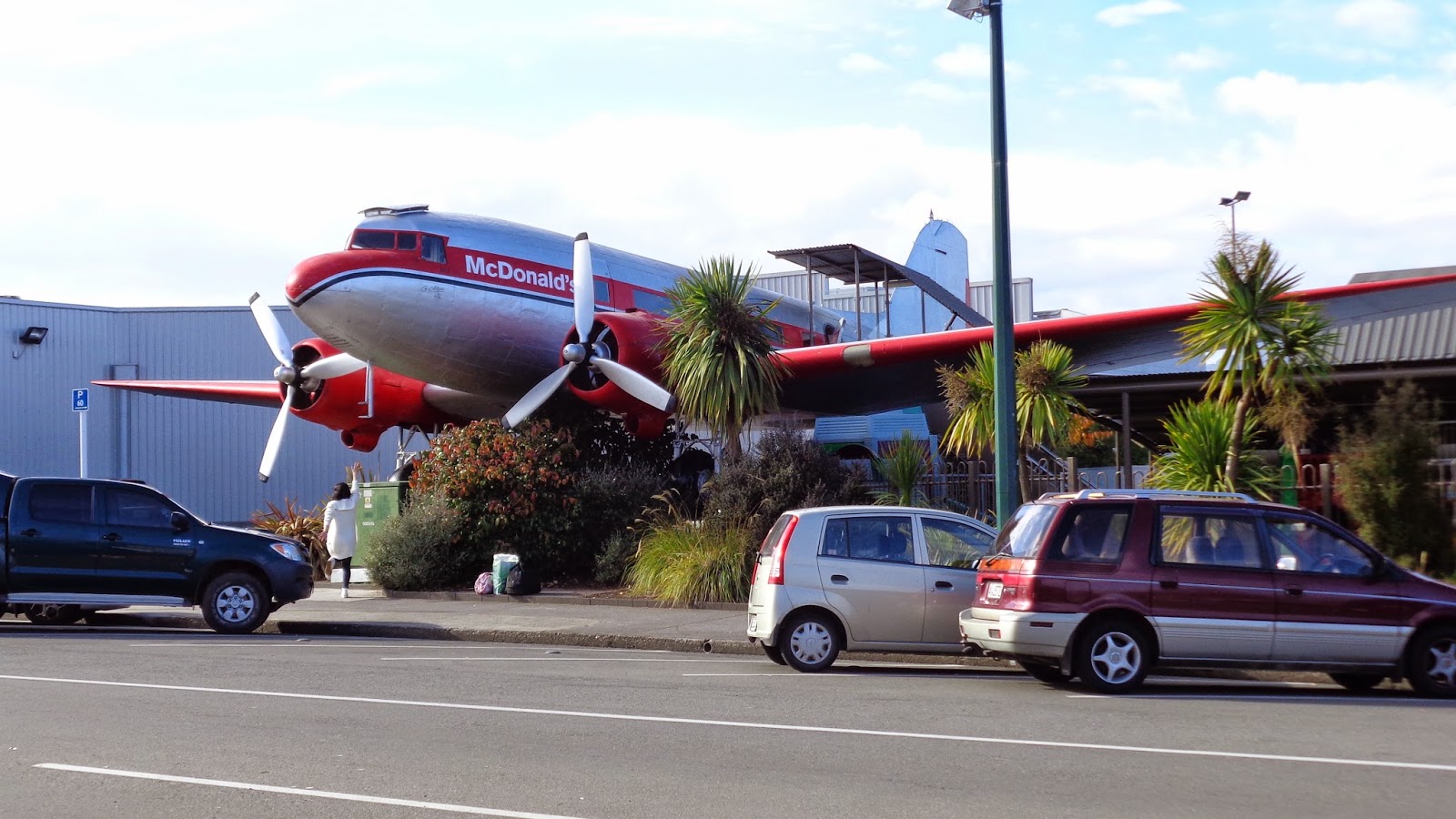
Given how stinky Rotorua is, we didn't want to spend the night there, so drove south to Taupo. It's low season in Taupo so finding a decent room was pretty easy, and we even managed to get one with a jacuzzi bath........which still didn't shift the smell of sulphur! After a pretty decent sleep, we had a monster breakfast, ate ice cream in a DC3 (McDonalds have a DC3!), then went to the Huka falls on the way back to Hamilton. 

The few days off continued and we managed to get across to Raglan beach to watch the sun disapear over the Tasman, then on Saturday a long drive up into the Coromandel Penninsula to visit the famous Cathedral cove. Amazingly, there was a point when we had the secluded beach to ourselves for about 20 minutes, quite a moment to be the only two people on one of the most beautiful places on earth. 

Sunday saw me back training, where I had my first nav flight with Scott. The trip we flew was fairly simple, being the one planned during the monster brief we'd had earlier in the week, but nonetheless quite interesting as I got a new perspective on New Zealand. As expected there are areas I need to tidy up but nothing disastrous, so i'm excited for my next nav trip. 

And finally, with our last few hours of free time we went to the Waitomo caves on a subterranean trip I will never forget! After a huge amount of effort getting into our wetsuits, we followed the guides down into the darkness, and began to explore the cave system. At points we switched our lights off, and the only illumination was light from the glow-worms that lined the ceilings of the tunnels and caverns. Nice to know that the light is actually created by mucus, but that's not nearly as exciting! The only bad thing about the tour was an eel about the size of my arm making an appearance, but after the racket we made jumping over waterfalls, it didn't show itself again. 

Alice has now left New Zealand, and after stopping in Sydney she's now steaming west towards the Indian Ocean and the next stop in Dubai. Hopefully given how much more flying I have to do ill be busy enough that the time will go quickly. Here's hoping!!

Sunday, 1 June 2014

Week 36: Solo consolidation and instrument flight

Right as its exciting me the most, at 0925 NZ time Alice jumped on a flight from Heathrow, and she is now somewhere over central Europe living it up in Business class as the jammy b*"th got an upgrade! Tomorrow i'm off to Auckland, and sometime around midday she finally gets here after what feels like forever. This week is gonna be immense!


Qantas 10 steaming past the Essex coastline

Training.....After managing to get past my 'first' solo, i've been quite fortunate to have a busy week flying with five events since Monday. On Tuesday I was back with my primary instructor Scott for another hour of consolidation in the circuit, which had been scheduled for 0730. The main risk with early flights is how the weather is going to muck things up, and at a temperature of -5degrees I was wandering around a Cessna in the darkness attempting a pre-flight. Due to the cold the aircraft was caked in ice, so we were delayed getting airborne as we needed to use the only de-icing bowser, a bowser that about 10 other aircraft also wanted! However, after the delay getting going I was treated to stunning views of the Waikato as the sun crept higher over the Kaimai mountain range.

After a few circuits with Scott he jumped out, allowing me to carry on for another hour to consolidate my flying in a solo scenario. This was complimented a few days later with another session of solo circuits, but this time with a lot more eventualities! As Hamilton is one of the busiest aerodromes in NZ, aircraft are required to book a slot in the circuit to avoid the Air traffic controller becoming overloaded. My flight was scheduled for 1545, but after a short delay where I had to refuel I finally called ATC at 1605 requesting a clearance, only to be told the circuit was unavailable and to call back. Given my point on the course I am not allowed to fly at night, and with official night commencing at 1737 that day I needed to be taxiing at 1619 in order to squeeze in my 1.3hr lesson. Time was ticking!

At 1618 I was finally given clearance, but now I was briefing myself on the fact the last 20 minutes of the lesson would be quite dark with the setting sun and a thick layer of overcast cloud. This in itself wasn't an issue, as a briefing is designed to prepare the pilot for the upcoming threats, and give the opportunity to plan how to manage the situation. The lesson itself went relatively well, but as I approached the 1.2hr mark there was a noticeable decrease in brightness, the runway lights now illuminated to give better reference. Initially I decided I had time to complete a final circuit, but as I reconfigured for the approach one of the passenger carrying aircraft called up, and immediately my plans were scuppered. Instead of performing a touch and go (landing followed by take off without stopping) I decided to change my request to a full stop. This was based on the fact a larger aircraft was approaching, and even though I had time to squeeze a circuit, if I had needed to perform an orbit (one complete circle) or go around, I would have landed during official night and would've been breaking the law. These are the sorts of decisions that are gradually placed on us as cadets, some completely without warning.

Following circuits I was yesterday back into the simulator examining VOR tracking. A VOR is a ground based navigation facility that pilots use to fly the aircraft along designated routes, as well as for aircraft orientation. This is another quirk of the MPL course, as Wings cadets don't start instrument flight in such detail for quite a lot longer. The session was quite enjoyable and a completely new skill for me, which is to be complimented this afternoon with NDB tracking (a different kind of beacon).The Garmin G1000 is starting to make significantly more sense!

This week it was my old housemate Ash's 40th, so we all went into town for a big meal. It would appear the restaurant we picked weren't geared towards big groups, as there was a single chef working frantically to cook 20 meals all at the same time! I have to say, it appears curry houses in NZ dont put much in the way of of spice; i'm not exactly designed for the hot stuff, but I genuinely feel the Vindaloo I had was about as hot tomato soup!

Sunday, 25 May 2014

Week 35: not much to see and a third first solo.

It would appear winter has well and truly arrived, with the Waikato being shrouded in fog most mornings this week, with the obvious disruption to training. I was scheduled early on Monday, and given this was my view during the drive in I had my reservations as to whether my chances of flying would be slim or none. 

As you can see only about five centre stripes are visible, so this put the visibility down to approximately 125m, which for an airliner would be Category IIIb ops. Now this means very little to most, asides from the fact the aircraft and airfield need some pretty modern kit to allow safe operations, and safe to say the Cessna 172 doesn't have it. So I wasn't surprised when my flight was cancelled, but on the upside as irritating as losing a flight is, getting a sight like this first thing in the morning is pretty good. Luckily for me I was rescheduled on Tuesday afternoon, and in glorious sunshine I flew my last flight with Scott prior to my check ahead of my third 'first' solo.


As mentioned, I have been lucky when it comes to flying, having flown both gliders and light aircraft since the age of 16. In both of these I have been solo, but in this case I still had to be assessed as competent by CTC instructors, so it counts as my first solo in the southern hemisphere and brings with it the expected nerves! Initially this assessment was planned for Friday, but after completing planning and briefing, my check was cancelled as the weather had deteriorated to low cloud and a 15 knot crosswind. Even with a reschedule for yesterday (Saturday), the weather still hadn't improved; so close but yet so far!

However, ever the optimist I found a checking instructor with a free slot, and after a few circuits with Kuni this afternoon I managed to clatter off into the big blue yonder on my own, passing a significant milestone in my course. The check wasn't without eventuality, as an Air New Zealand which had started it's take off roll decided to abort, so I got a real late go-around (always a nice skill to practice). 

Next up ill go back into the circuit with Scott, immediately followed by an hour of circuit consolidation. This is followed by another hour of solo circuits, then that's it for general handling as we move back to the simulator and onto navigation aid tracking ahead of the navigation flights. Ideally ill get the flights flown this week, as Alice arrives next Tuesday and I fully intend seeing more of this beautiful country with her! Let's just hope the weather behaves itself too, otherwise we'll be going for the windswept look in holiday snaps!

Sunday, 18 May 2014

Week 34: Time seemingly stands still

Unfortunately for me, this week has gone incredibly slowly as I flew on Monday, then haven't been scheduled since. The main irritation is that I am so close to flying solo, but have now sat on the ground all week bored senseless, pretty much waiting for the schedule to be published each afternoon. This frustration is probably exacerbated by missing my family and girlfriend, and the fact i'm on the other side of the world being unproductive makes me feel quite helpless! It'd be nice to get the roster a few days in advance as this would give the opportunity to make plans and see friends, but given previous courses are slightly behind due to the weather, we're effectively on permanent standby until we get on schedule. 

On the upside I have been scheduled for a flight at 0900 tomorrow, so hopefully I get off the ground. Although the rather comedic weatherman has already forecast early morning fog, so my plans to aviate may be scuppered! But again this concern is fed by the fact Alice is coming in two weeks, and I don't want to be behind when she arrives so that I need to fly whilst she's here. So because your attention is probably waning right now due to the lack of pictures, I saw this fellow in the gym. And we complain about ants in England?! 

As I have had nothing to talk about, and someone I know is applying to the easyJet MPL, I thought i'd talk about airline and new technologies that have made the news recently. easyJet as an airline have often embraced new technology, and their commitment to low prices means they need to do everything possible to lower costs. Certain costs like airport charges and staff salaries will only ever tend to go one way, but with the continually rising price of crude oil, making the operation more fuel efficient needs to become part of airline culture. Those recent ones (ie. last 2 years) include:-
  • Nano Technology- 8 aircraft were coated with an ultra thin polymer, developed for use on Military aircraft. The paint (which only weighs 4oz for the entire aircraft) prevents the build-up of debris/dirt on the surface, thus potentially lowering fuel costs by 2%
  • Recaro seats-  seats constructed by the famous racing car outfitters were designed specifically for aircraft, and are approximately 25% lighter than their conventional counterparts. Each aircraft fitted with the new seats weighs roughly 600kg less, so the fuel savings are obvious!
  • Ash aware- following the disruption caused by the Icelandic volcanic ash cloud, easyJet became part of a group developing effective ash detection systems, utilising one of the Airbus aircraft during the equipment trials.
  • Electronic flight bag/paperless aircraft- legally all aircraft engaged on public transport flights are required to carry on board paper copies of the charts and approach plates relevant to the airspace in which they are operating. Again this is a weight saving exercise, with the relevant documents being copied electronically on a tablet style device, easy to use in the flight deck.
  • Inspection drones- this is the newest technology, using remote controlled drones during engineering inspections. The drones are equipped with lasers and cameras which can spot any defects significantly quicker than the human eye, and these are then electronically mapped. The plan is that the pilot then wears some rather fetching 'smart' glasses during the walk-around, and if he spots a defect which isn't already indicated on the inside of the lens, he can report to engineering. Again, this should save time and money, as well as prevent angry passengers, as delays due to technical faults don't require an engineer to be flown out for every inspection. 

The drone, credit to telegraph.co.uk

So that's it, hopefully more to report next Sunday and a happier Kieran! And if the above has been helpful ahead of any upcoming assessments, you're welcome. 

Sunday, 11 May 2014

Week 33: round and round we go!

Following the completion of stalling in both the simulator and the aircraft, I moved onto the next significant milestone: Circuits. Although I have eluded to the accelerated nature of the MPL, circuits are something that cannot be rushed and it is the cadets competence that dictates the pace of progression (obviously within reason!). The circuit is effectively a method of organising the traffic around an aerodrome, so that Air traffic can maintain some semblance of order, and the actions of other pilots are both predictable and safe.

Put simply, the circuit is split into five sections, or 'legs'. These are upwind, crosswind, downwind, base and final. The direction of landing will normally be into wind (as this helps with the generation of lift at low speeds), so dependent on strength and direction the pilot is responsible for arranging their profiles so that the aircraft tracks along the right path. For instance, if the wind was flowing up the page, this would be a crosswind, and the aircraft would gentle be pushed away from the airfield. To counter this the nose needs to be pointed slightly into wind, and hopefully with a visual reference in the distance the pilot can tell if they're tracking correctly. 

As well as flying the aircraft, it is the pilots responsibility to correctly communicate with Air traffic control, as there may be a requirement to hold position or use a shortened approach path etc. This means flying, talking, and running checks, as well as looking for other aircraft also in the circuit or joining. Very quickly it becomes apparent how much the pilot workload ramps up, and this is why we are given 5 lessons with an instructor purely in the circuit, so that after our fifth flight we are confident and competent enough to fly off into the big blue yonder on our own!

I have performed two of these lessons and both were quite exciting. For the first I was in the circuit for 90 minutes at Hamilton, so had to be on form with the radio and planning as I was sharing the pattern with 3 others. Annoyingly the wind was variable in direction, causing tailwinds at times which caused enough windshear on final approach to decrease my speed by 5knots at 50 feet. However, this additional challenge was something to be embraced, and in my first lesson of circuits with CTC I was able to complete everything required asides from glide approach's.

Scott flying from the right on Final approach at Te Kuiti

In my second I sat in the back seat for Dan's flight (he had stalling), and after the wind had gently drifted us South, Scott flew us into a small uncontrolled airport called Te Kuiti where we could swap allowing me to fly some circuits. The challenge here is that the runway is relatively short, only 5m wide, and is surrounded by high terrain requiring quite a bit of planning, so although I now didn't need to worry about the radio as much, my flying needed to be accurate to maintain safety margins. As i'm sat here typing away, it's safe to say I didn't make a complete dogs dinner out of it!

After a few days hanging about Clearways, Chris, Matt and I decided to venture up to the Coromandel Peninsula to visit the Hot Water Beach. The beach exists as there is a fault line running close to the surface, so at low tide if you dig into the sand hot water fills the void giving a self built hot tub. And by hot I mean scalding; water temperatures commonly reach 65degrees celcius, so buckets of sea water are needed to cool things down (as Matt found out the hard way!). It was completely worth the effort of driving for two hours, even if we did need to leave at 0630 to get there before the tide came back in.

After that (and given we'd driven two hours to get there), we drove a bit further to a spot known as Cathedral Cove. It's one of those incredible spots that isn't particularly well publicised, but once you get down there you can see why the arch was seen as a beautiful enough spot to be the gateway to Narnia in one of the chronicles films. This was also a good opportunity to suss out whether the two spots were worth a visit again (which they definitely are), so rain or shine Alice and I will definitely be venturing up to the Coromandel during her trip!

And finally, as we drove through Paeroa we stopped at the visitor centre to pay homage to a rather large L&P shrine. L&P is a soft drink originally made in the small town of Paeroa that tastes immense, and the Coca Cola company seem to agree as they bought it! Clearly showing my love....