Monday, 25 August 2014

Week 47 and 48: Instrument flight and a mad rush to get home.

Apologies for missing an update last week, but unfortunately I was rather distracted by what was going on at home. My sister who was 8 months pregnant had been rushed into hospital, which eventually led to her being in intensive care, so naturally I was desperate to get home sooner to be with her as I felt helpless on the other side of the world. My line manger Troy was fantastic in getting through my flights, and my Instrument instructor Phil even worked overtime to get me finished quicker. The right people were brilliant at the right time, and for that I am hugely appreciative. Obviously it's not something I want to discuss further, but I am now a proud uncle for the first time, baby Annabel my new niece.

 Wellington International from 9000ft

During week 47 I completed my last few simulator sessions in readiness for instrument flight in the aircraft. The last two were flown to represent real flight profiles, from the planning to the workload en route. During my first ops route I could have been quicker with the tasks that needed carrying out, and as I took a leisurely pace earlier I gave myself a bit of a mountain leading up to the approach. Fortunately I sorted this for my final simulator flight, so felt a bit more confident ahead of my first flight in the aircraft. Obviously in keeping with the rest of the course the weather put the brakes on, with a deep layer of cloud and a low freezing level keeping me grounded. This is because flight in cloud above the freezing level will cause icing, and as the Cessna doesn't have any anti-ice equipment the flight couldn't go ahead.
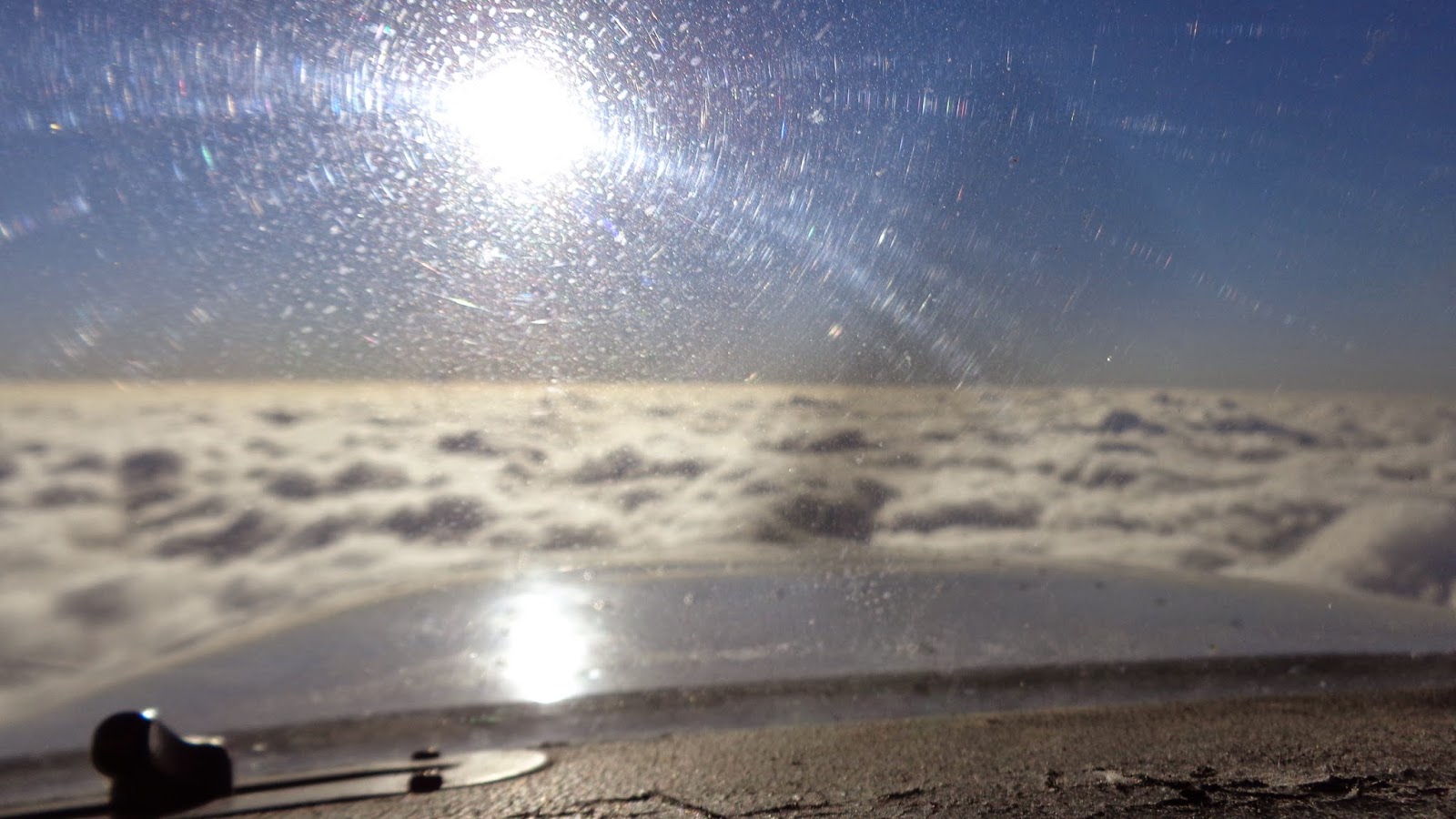
Chasing the sun West

When the weather did show signs of improvement I was lucky enough to be part of a long trip down to the top of the south island, flying the first and the third legs of a three flight day. The best part about the trip was that I was in the back seat when we crossed the Cooke Strait between the North and South islands, so was able to sit back and enjoy the views. Hopefully some of the pictures do it justice.

last time I race the Cessna's shadow whilst training

Luckily for me and my efforts to get home quicker I completed my final flight on Monday afternoon, and after Troy had offered to complete my sign out the next day I was in a position to change my flights. Annoyingly the earliest flight I could get was 48 hours later, but after rapidly completing the sign out and managing to join another cadet who was heading home on the Tuesday, I went to Auckland in the hope of finding some luck. Thankfully I was able to get a flight that evening getting me to Gatwick, and after ~30hrs of almost sleepless travel I made it home.

I've now got a couple of weeks off before my next phrase of training in Bournemouth, time I want to spend helping my sister as much as possible, getting to known my niece and catching up with Alice and my parents. It's not long before the most intimidating part of my training commences, so I plan to use the time off as much as possible. 

Sunday, 10 August 2014

Week 46: Precision is everything

This week included work on the instrument landing system (ILS), an approach method that is considered as 'precision'. It is deemed as more precise as the pilot now has guidance in both azimuth (direction) and elevation (level), and is the principle instrument approach used at most commercial aerodromes. I was looking forward to this one the most as it is the type of approach I will fly for the majority of my career, so the simulator was positioned at Auckland to give it a go.

As previously mentioned the approaches we had worked through were known as 'non-precision'; effectively directional guidance is given to get you to the aerodrome itself, and the pilot must use the advisories on the plate to try and achieve the planned descent profile. These types of approaches can be flown very accurately, but the margin for error is a lot larger than with the ILS, and therefore additional safety factors are built in. The main one is the Minimum descent altitude (MDA); this level is indicated on the plate, and should be seen as the 'descent floor' for the procedure, below which the aircraft must not descend unless they are visual with the runway. The aircraft can fly level at the MDA in the hope of getting visual with the runway, but the longer this takes the steeper the final descent would have to be in order to complete the landing. In the case of Hamilton this is over 500 feet which puts the aircraft about a mile from the airfield, so when there is a combination of poor visibility and low cloud, the pilot is unlikely to complete the approach. 

In comparison the ILS has a 'decision altitude' (DA), a point where the pilot looks out the window to see if they are visual and can continue the approach. In the case of the ILS the aircraft can legally descend below this level, but if a missed approach is to be executed this will have been commenced as the aircraft passes the DA. This isn't as critical as the non-precision approach, as the aircraft would still be receiving track and level guidance, and as long as the aircraft wasn't dangerously low already it won't hit anything. This is prevented with the rule that if there is more than "half scale deflection" on the glideslope indicator, a missed approach must commence. 

This is the primary flight display from an Airbus instrument panel. In the centre is the artificial horizon (AH), the airspeed indicator is on the left (ASI), direction indicator at the bottom (DI), and the altimeter on the right. Between the AH and the altimeter there is a magenta diamond with four dots and a line. This is the glideslope indicator, the top and bottom dots being full scale deflection and the line being the centre. To fly the ideal approach the pilot will plan a rate of descent, then with minor adjustments they should be able to keep the diamond on the line, which will move to indicate what action is required from the pilot. In the case shown the diamond is indicating 'fly up', but this is due to the aircraft intercepting the glideslope from below so there is no issue. If however they get this indication once they had already intercepted the glideslope once, there would be a consideration that a missed approach must follow if the situation isn't rectified. 

For the moment these types of approaches are busy, but certainly manageable as the aircraft is easy to manipulate. When we get into the Airbus however the aircraft will have so much more inertia and is going considerably quicker, so accuracy is key to prevent any errors snowballing. Next up we've got more approaches and then we should be moving onto GPS routes in readiness for our last 5 flights in the Cessna. 

Sunday, 3 August 2014

Week 45: Instrument flight

Flying this week has completely changed, from now on views out the window for 90% of the flight are purely for enjoyment rather than reference. The visual flight rules phrase for all intents and purposes has now finished (asides from a few upset recovery flights), further details flown with reference to the array of screens, dials, and instruments within the cockpit. Given this is the type of flying that will dominate our careers, the flights have almost taken on a different feeling, with a lot more procedural flying giving the perception of a more professional cockpit environment. That's not to say we were zooming about yelling yee-haa at the top of our lungs, but instrument flight inevitably leads to a very different mindset. 

Holding was the first port of call, initially looking at VOR (VHF Omnidirectional range) and NDB (Non-directional beacon) holds. These two things are ground based navigation facilities, sending out horizontal signals that aircraft can utilise to orientate themselves, as well as navigate from/to. They are also often used as a fix for holding, and as Hamilton has both types there are holds/approaches established over each, which were used during my simulator sessions. For those that care, an NDB is pretty much just a vertical aerial, and that's a VOR ----->

Given how intelligent modern aircraft are, holds tend to be flown with the autopilot engaged, the flight management computer continuously updating the aircraft's position in space so that the ideal hold can be flown with varying angles of bank. As good as the Garmin is, it's not that good so hold flying is as much about mental calculation as it is accurate flying. The calculations are focused on two areas:-
  1. Timing- the ideal scenario is that the wings level legs are flown to last 60 seconds in still air conditions, the corresponding distance giving the hold a fairly standard size. Nil wind is incredibly rare, so during the outbound leg if there is a headwind one additional second is added per knot of headwind, whereas with a tailwind one second is subtracted per knot. Therefore a comparison needs to be made between the aircraft's true airspeed and ground-speed, and how that affects the times, the resultant difference applied accordingly.
  2. Tracking- If there is a wind blowing across the hold, dependent on which side it's coming from one of the turns will be made a lot tighter and the other significantly wider. Without some sort of adjustment this is an unacceptable situation, as the aircraft will quickly leave the protected holding area and tracking back to the holding facility becomes increasingly more difficult. At CTC the double/triple drift technique is used, and as a result the outbound/inbound legs are not parallel but the hold is significantly more manageable. I've attempted to show the holds pictorially (sorry it's naf!); with a wind from the holding side the drift is tripled, and with the wind on the non-holding side the drift is doubled. This means that with the tighter/wider turns the new tracks help to achieve the correct inbound track. Both holds start at the cross, and go clockwise. 

Once the holds were meeting the right standards, procedural approaches were flown commencing from the hold facility. This involves flying away from the hold descending to a certain altitude, turning back onto a track towards the airfield, then descending at a certain rate of descent to achieve a procedure designed descent gradient, a gradient which ensure separation from obstacles on the approach. In some cases these approaches contain level advisories whereby the aircraft should be at a certain altitude at precise distances, but if the airfield has no facility for transmitting distance information the planned rate of decent needs to be flown as accurately as possible. These procedures create a much higher cockpit workload than with a visual approach, and to ensure a good approach is flown core skills of pre-planning, briefing and prioritisation are vital. The chart on the left (or plate) is for the VOR DME approach to runway 15 at Laos. The top section with a river running through the centre is a top down view which aids lateral planning, and the bottom section gives guidance for the vertical profile (The race-track hold can be seen to the right of the magenta text). There is a vast amount of information contained on the plate, a lot of which needs to be taken in prior to the approach being flown. This demonstrates how the workload quickly ramps up, as there are many criteria that must be met for the approach to be deemed safe. Plate not to be used for navigation.

Next up is GPS approaches, where imaginary points in space establish waypoints, but in essence the aircraft is flown as if there was something on the ground. The Garmin system is going to be of vital importance for this element, and without sounding like an idiot I am more scared of tuning the system than I am of flying the aircraft! We'll then move onto precision approaches using the instrument landing system, which ill talk about more next week. 

Sunday, 27 July 2014

Week 44: VFR over and back into the books

This week I met a significant milestone with my training, having completed my VFR competency assurance flight. As I mentioned many moons ago, VFR means 'visual flight rules', and is in essence flying the aircraft by outside reference using the horizon and depth perception to navigate the aircraft. The C/A wasn't perfect and I did have a few brainfarts, but thankfully I passed and can move on to IFR.

This is about to take on a new level of importance

Modern airline operations are rarely conducted under VFR conditions, and the C/A signifies the start of the more challenging element of the course, Instrument flight rules (IFR). During the visual phrase the required weather minima were massively restrictive, with both cloud and visibilty regularly halting flights as their values were less than the amount the law requires. However, with instrument flight the aircraft is flown by reference to information on the panel, information which commonly receives input from ground based facilities to aid navigation, so the flights can happen in significantly worse conditions. The Cessna's Garmin panel now takes on a new level of importance, and to really force us to use only the instruments we'll be using a hood which effectively blocks our view out the window. Rather fetching...

In preparation for our first instrument flight, the MPL course have 8 sessions conducted in the Twinstar simulator. Chances are i'll only get through the first few this week which focus on holding, so after a briefing on Saturday i've been back at my desk attempting to get some of the information to stick! We've all been on board an aircraft when the pilot happily informs us there'll be 10 minutes (or more) of holding before conducting an approach to the destination. This hold can be for a variety of reasons, from insufficient capacity at the airfield to bad weather on the approach, or even equipment failure in either the aircraft or on the airfield. In essence the hold is there to delay the onward movement of the flight, so it's important we can do it properly as we'll pretty much have to do it on every flight! 

The hold itself is a racetrack pattern, with two straight legs and two 180degree turns. Each of these parts should take one minute, so simple maths says one hold takes 4 minutes. What we will learn in the sim is how to get into the hold, what headings to fly within the hold to remain within it's protected airspace, and how to manage the aircraft in preparation for an instrument approach. What we do here in New Zealand is really an introduction to instrument flight as we will really get into it in the Airbus back in Southampton, but for the moment there's lots to learn and i'm quite excited to learn a completely new skill. Hopefully i'm not awful!

 Pictorial view (Plate) of Hamilton hold in the centre 
with associated instrument approach

Sunday, 20 July 2014

Week 43: What a difference a week makes!

After the weather continuing to frustrate the multitude of cadets trying to fly, this week the skies finally cleared and training changed up a gear. Over the past 7 days I have managed 8 flights in total, consisting of 3 solos, 3 Ops routes and 2 night flights. And with that amount of progress I am now in a position to take flight exercise CE042; Ops route VFR Competency Assurance. If I were a wings cadet this would be similar to progress test 1, but as I am flying on the MPL our assessments are slightly different. During training each lesson has basic competencies which are required to be achieved for the lesson to be a success, so strictly speaking the C/A tomorrow is no different to a normal lesson. That said, the fact this is the final VFR flight ensures there is an increased level of stress ahead of the flight!

My flights this week have consisted of three main areas; solo's, duals, and night flying. For the solos I managed to travel quite a few miles, as well as visiting New Zealands busiest uncontrolled aerodrome, Ardmore. This sits just south of the city of Auckland, and with the international airport the area has lot's of restrictive airspace, into which it would be quite easy to stray and get a telling off. During the approach to the aerodrome there are some quite strict procedures to follow designed to keep traffic moving in different direction roughly separated, whilst also continually looking for other aircraft which may be a potential threat. Unfortunately whilst having priority another aircraft cut in front of me so I had to start the approach from scratch, but asides from an elevated workload the visit went without further consequence.

I also experienced a new type of flying this week, Night VFR. As the later sim flights on the MPL course can simulate night flight quite easily, there isn't a great requirement to fly a traditional night rating course. CTC's approach is therefore tailored to our needs, so during the first flight we learnt how town's can look closer at night, approaches and landing are a lot more difficult, and the instruments take on a new level of importance. For the second I took another trip to Ardmore (thankfully with a lot less traffic about), and after watching another cadet take on the circuit, I flew a few circuits, transited back to Hamilton, and did a few more circuits before the fog rolled in. Personally I found the landing the most exciting part of night flight, especially when the landing light was turned off! During the approach you feel like you're descending into a black hole, so to achieve a touchdown on the main wheels the landing attitude is selected and the side lights indicate rate of descent. I quite enjoyed it, but scarily the next time I land a real aircraft at night it will be a 50 ton jet!

Downwind for Tauranga


The final element of my week was the 3 Ops routes I flew with my instructor Scott. I have been incredibly lucky that Scott has made the routes quite challenging, and to simulate the C/A he's only given me the route/scenario an hour before my take off time. They have ranged from picking a passenger up at an aerodrome where he acted as a passenger, to flying around Auckland utilising him as a member of crew that I could delegate tasks to. During the flights I would then be given unusual simulations such as a rough running engine or sick passenger, so that the pressure was kept on throughout the profile. I feel ready for the C/A (which isn't to say i'm not nervous), but have some work to do so Liam and I are going to go through some theory as we both have the C/A tomorrow. 

Hopefully tomorrow goes well and in no time ill be in the sim working through instrument flight. Lot's more fun to come.....


Sunday, 13 July 2014

Week 42: New Zealand gets smashed!

This week started with plenty of optimism, as the skies were clear and the flying programme pretty packed. I managed a trip down to New Plymouth on Monday, which took me close to Mount Taranaki (which was used to mimic Mount Fuji in 'The Last Samurai'), as well as close to the central Volcanoes. Unfortunately all the summits were shrouded in cloud, but regardless they were an impressive sight. After getting close, my next nav was a trip south to get a closer look at the North Islands impressive Volcanoes, Ruapehu and Ngauruhoe. The one on the left is Ngauruhoe, and as i'm sure many of you know was Mount Doom in the Lord of the Rings. The day before the crater had in fact been smoking which would have been exciting, but it'd calmed down by the time I got there. 

Following the solo's I was back in the aircraft for a dual nav route, but this time under the guise of an 'Ops route'. Some of you may feel this is purely semantics, but the name change indicates a real difference when compared to a normal dual lesson, effectively making the flight one where the student acts as commander on an operational flight. Initially the strong winds and turbulence did their best to stop the flight happening, but after much deliberation I decided the conditions were satisfactory when considering if the operation could be conducted safely. Yes at times we got a bit of a kicking as there was plenty of mechanical turbulence from the wind flowing over high ground, but the flight was manageable and the decision to proceed was proven correct. 

Another subtle difference with the Ops routes is that the flight contains more scenarios which have to be considered and acted upon. In the case of my first one, my instructor simply said that during a cruise check the carbon monoxide detector was indicating 'caution', and I now had to act with that information. The first concern is that the human body actually has a stronger affinity for carbon monoxide than it does oxygen (about 200 times!), and the CO displaces the oxygen from the blood, effectively suffocating the individual. The longer the CO poisoning continues the higher the likelihood of passing out, so time is of the essence. The most common cause would be a crack in the exhaust manifold, as the hot air to the cabin is heated from the hot exhaust. So the air is shut off, and the windows opened to ventilate the cabin. 

Once you have solved the problem, or at least stopped it getting worse, the best plan is to land as quickly as possible. One of the big issues with CO poisoning is that humans are very poor at recognising the symptoms, and you could have very little knowledge of how close you may be to passing out. Working quickly and being prepared to make fast confident decisions, the next mission is to fly an accurate diversion to an alternate aerodrome. I chose to fly to a small aerodrome called TeKuiti; it is unattended, has no air traffic control, and the runway is tiny, but in an emergency best practice has to be more flexible. 

I managed another flight this week up to Ardmore, which is New Zealand's busiest airport. Normally the traffic pattern is rather intimidating as so many aircraft are trying to fly so close to Aucklands airspace, but as I left Hamilton at 0740 and it was pretty windy, I pretty much snuck in and out without seeing anyone else (at least I hope there was no-one else!!). I was due to fly another solo on Friday, and one today with a night flight, but both days were cancelled due to high winds then low cloud. With four days of good weather ahead there is a real possibility I could finish my VFR phrase by the end of the week, and if that does happen I could in fact get home on time, but there are no guarantees, just hope!

Sunday, 6 July 2014

Week 41: the inevitable has happened!

It is with great pain that I have to report that the slow start and poor weather have doomed our departure, our head of training this week confirming our course has been delayed and we will leave 3 weeks later than planned. Consequently I am now missing Alice's Birthday, our holiday to France, as well as an incredibly important family event, so I am rather ticked off. There's no point in my discussing it because ill probably end up crying, and my laptops not waterproof!

After what feels like an age I managed to fly this morning on what was a pretty interesting route. I basically took a solo tour of the Bay of Plenty, calling in at Rotorua and Tauranga during my second solo navigation over here, and with the sun rising in the east and the still conditions, I had a really good 2 hours. I tried getting some pics, but as I was concentrating on flying the aircraft I just said the video running, and grabbed a few stills. Apologies for them being a bit blurry, but it's the best I could manage!

 The Beautiful South Pacific

After my solo I then caught up with Scott and we clattered off on a split flight duty, where I took us northbound to Whitianga, then Dan tracked the east coast back to Hamilton. During my leg I went into New Zealand's busiest airfield Ardmore; the closest description I can offer for the radio chatter during my time in the circuit was 'noise', but it was good to visit a new place. I then took us north and managed a visit to Great Barrier Island, where the aerodrome plate actually says to watch for wild pigs! 

Unfortunately the Weather is due to turn rubbish in a few days so the misery drags on, but hopefully ill manage a couple more flights before i'm cemented to terra firma again. Life's a b*%ch!