Monday, 15 December 2014

Week 64: competency assured!

Basic is at an end! After 29 flights in multi-crew jet aircraft, I have passed my competency assurance which symbolises the end of the basic phase and fixed base flight simulation. When I return to the sim hall, the motion is going on and the workload is only going in one direction, so happily I am enjoying a week of relaxation before getting back into it. If I were on the Wings course, following my CPL skills test I would have been awarded my first bar to wear as part of my uniform. As I am not on Wings but following the MPL course I do not ever receive a CPL, so the end of basic is seen as the point where we deserve our first bar. This is chiefly due to basic being a combination of CPL, instrument rating (IR), and multi-crew cooperation (MCC), so the next time the uniform goes on it will include a silver bar!

The flight itself was no different from any others, but with the added spice of a bit of nervousness to help things along. Strictly speaking there is no pass/fail like there would be on a CPL skills test, but the MPL course is continually assessed so there are standards that must be met on every flight. After some delays due to the simulator having a hissy fit, we get on with our tasks now under a bit more time pressure. Matt kicked off taking us from Liverpool to East Midlands, Chris onward to Leeds Bradford, then I completed the triangle with a route back to Liverpool John Lennon. As part of the flight we expected a normal departure, en route phase, a non-precision approach, a go around, an engine failure, and a single engine ILS using raw data. Without the time pressure this was a lot to get done in the time, so from the beginning we were immediately pushed to work faster than usual. The most noticeable was how quickly we had to start briefing the approach when we had only just completed the departure; in my case a rather chunky short cut meant I was briefing as we entered the hold, so I had to get Matt to continue flying whilst I briefed him on what I planned to do. We all left having met the required standard, so now we're looking to the next phase.

From now we move onto the Airbus technical groundschool, so heads back into the books with a rather sizable chunck of knowledge to ingest. Even though we have been flying the Airbus since October, we have only touched on the technology the aircraft has. This is because the regulators insist that the Basic phase is flown in a generic jet, so we have not been allowed access to the technical knowledge. However we have seen a lot of the systems in operation, so hopefully working through the groundschool should be made a little less ominous!

During my week off it's been my mums birthday, so I was able to catch up with my family and enjoy a trip to Winter Wonderland in Hyde park. To say it was crowded would be an epic understatement, but it was good to see all the bright lights and a trip to London is never a bad thing. Given this was followedup by a huge Chinese takeaway all in all id say a successful day out!

Back to Nursling on Thursday, so i'm briefly working through some of the material we've been sent for the course. We've been warned not to run ahead and start on the technical stuff as theres a strong risk of misunderstanding the imformation, but the new operating procedures have been worth looking at. On the way down I need to swing into Gatwick as Alice has a uniform fitting, but then its back to Easteligh ready to start filling my brain!

Sunday, 7 December 2014

Week 63: route flying, diversions, and explosive decompressions

Continuing from our start last week, we flew more 2 hour flights but with increasing levels of complexity and variety. As much as the workload is high, with the coping strategies we have been given it becomes significantly easier to manage. To build on our experience and continue to test our comfort zones, the latter flights include fabricated scenarios which required us to decide to either continue to our destination, return to where we started, or divert to a new airfield. In my case I had to fly a relatively short flight from London Stansted to Manchester International, but with the added pressure of minimum fuel to make the flight realistic. Some may say that this is wreckless and planes should depart with plenty of fuel, but taking more than is actually required means extra weight, and extra weight means extra fuel burn, which in the long run costs money! 

During the route, on first sourcing the weather conditions for Manchester they were poor but legal, so with no equipment failures continuing remained sensible. However, given the conditions being so close to the legal minima, myself and Chris decided to formulate a contingency plan in case we had an issue completing our first approach. Our logic was that even the slightest deterioration would make an arrival impossible, and as our fuel state meant we could only afford to make one approach before having to divert, we wanted to have a plan ready in case of a go around. At one mile from touchdown a vehicle strayed onto the runway, so with the inevitable missed approach we started for our alternate which was Liverpool John Lennon. Given the close proximity of the airports and the continuing reduction in fuel, there was no time to go to a hold to rebrief, so I had to do it on the way whilst setting up for the next approach. To add to our problems the closest runway lighting went out of service, but by having to fly slightly further we had the chance to take a deep breath, relax a little, and fly a fully briefed approach. Upon touchdown we landed with 20kg above our final reserve, so no paperwork as it was legal!

We also got to look at high altitude upset, as well as explosive decompressions and the requirement to perform an emergency descent. Slightly different to other points of flight, initially flying the aircraft isn't the most important consideration, but getting your oxygen mask on and communicating with your partner to ensure they have theirs on! Once oxygen is flowing, the pilot flying selects an altitude at which breathing is possible, then winds up the speed to the maximum permisable so the aircraft descends quickly. Meanwhile there will be a lot of panic in the cabin as the 'rubber jungle' drops from the overhead, but concern for the is second to getting the aeroplane down. I'd like to think I dont look too tragic in my mask!

I now have two more details (one of which is my competency assurance flight), then the basic phase is complete and I am halfway through my Airbus flights. The alarm is set for the unfortunate time of 0340 tomorrow so ill be off to bed nice and early, so wish me luck and hopefully ill be wearing my first bar by next week!

Monday, 1 December 2014

Week 62: some context and a visit to easyJet HQ

As we have progressed through the basic phase of training, we have become increasingly more confident and proficient at operating a medium sized jet aircraft. However, thus far operations have been quite false as they've mostly involved a take off, pottering round the local area, routing back to the hold then flying an instrument approach. Things took on a more realistic feel this week though, as we began to look at routes which we could be flying in the not too distant future, so we've gained invaluable exposure to the 'operation' rather than just operating. I flew the first leg from Heathrow up to Prestwick starting on stand 511 at terminal 5, and Chris flew the return leg back to London. To give a flavour of the flight, tasks included:-

  • Power-up: The aircraft was 'cold and dark' when we arrived, so we had to run through the process of safely supplying the systems with electrical power (initially external, progressing to the APU)
  • ATIS: Automated terminal information service........the weather and what's not working at your point of departure, a computer voice reading the details on a VHF comms frequency.
  • Clearance: What clearance are air traffic going to give us so we can plan the departure.
  • Cockpit prep: ensuring that the required information is displayed, and systems are working correctly.
  • Departure Briefing: Led by the pilot flying, an opportunity to discuss the departure, confirm plans, raise any concerns, and most importantly share the same thought processes.
  • Start up: requesting from ATC to start engines, confirming with the ground crew it's safe to do so, and getting those engines spinning!
  • Push back: Talking to the ground crew to have the aircraft safely pushed away from the stand and into the live taxiway
  • Taxi: probably the most difficult part of the trip as there are so many spots to get lost!
  • Departure: fly the take off and departure as planned, adjusting the plan as necessary as ATC dictate.
  • Climb: Continuing climb into the en-route phase towards cruising level, which for my flight was 36,000ft (FL360)
  • Arrival planning: Pilot flying will begin to think through the arrival, gather information on the destination such as the weather, set up the aircraft
  • Briefing: Again pilot flying takes the lead but it's more of a conversation on the upcoming approach. When the aircraft is shifting at about 7 miles a minute, and the brief takes easily 10 minutes, it's easy to see how being concise is important or starting early!
  • Descent: using the rule of thumb of 3 times the height in feet, from FL360 I needed about 108 miles to complete the descent and another 12 miles to slow down, so at the latest I needed to start down at 120 miles from Prestwick. Amazingly, if I hadn't started briefing at 200 miles to go, I would've been behind and the approach would've been a mad panic!
  • Approach: Fly the approach to a hopeful successful landing. In our case the first approach was unsuccessful due to poor visibility, but the conditions improved enough for a second one to land.
  • Landing/taxi: quite a bit easier at Prestwick!
  • Parking/shutdown: get the aircraft onto the stand, shut the engines down, and get ready for the return leg!

So as you can see there was plenty going on before, during and after the flight, so the next time someone pokes fun saying the autopilot does everything, i'll happily be telling them that if the autopilot wasn't there they'd be taking the bus to Scotland!

In other news, this week EZMP03 had a visit to Luton to gain exposure to the easyJet operation, as well as building knowledge on a company that we will shortly be working for (and it is shortly, 15 weeks to be exact!). We started with a presentation from two current pilots, Captain Simon Kneller (Head of new pilot training) who is responsible for us up to the end of line training, and SFO Mark Farquhar, our new liaison pilot. What struck me from the presentation was how enthusiastic both were about the company, and even though the face of easyJet has somewhat changed in it's 19 year history, there was a real belief that everyone still remains as one team. 

It was then time to grab our ID's and head over to Hangar 89, the rather large and rather orange building at Luton that acts as easyJet's headquarters. Here we were given a tour of the crew room, the first point of contact each day for both cabin crew and the flight crew. This led nicely to lunch in the H89 canteen (I recommend the pulled pork baguette), and with bellies full we were off again, this time making tracks towards the main terminal. This meant the most exciting part of our visit was upon us, and we were off to the ramp to get up close and on board an easyJet Airbus A319.

Given we were like a pack of giddy school children, we were split into two groups for the aircraft tour. I was with the group outside the aircraft, and rather than just have us running about like headless chickens Mark took us around the aircraft as if he was doing a pre-flight walkaround, so we could gain an improved understanding of the aircraft. There were plenty of opportunities to take pictures, ask questions, and in general just stare in awe at how much larger the A319 is compared to anything else we have flown.

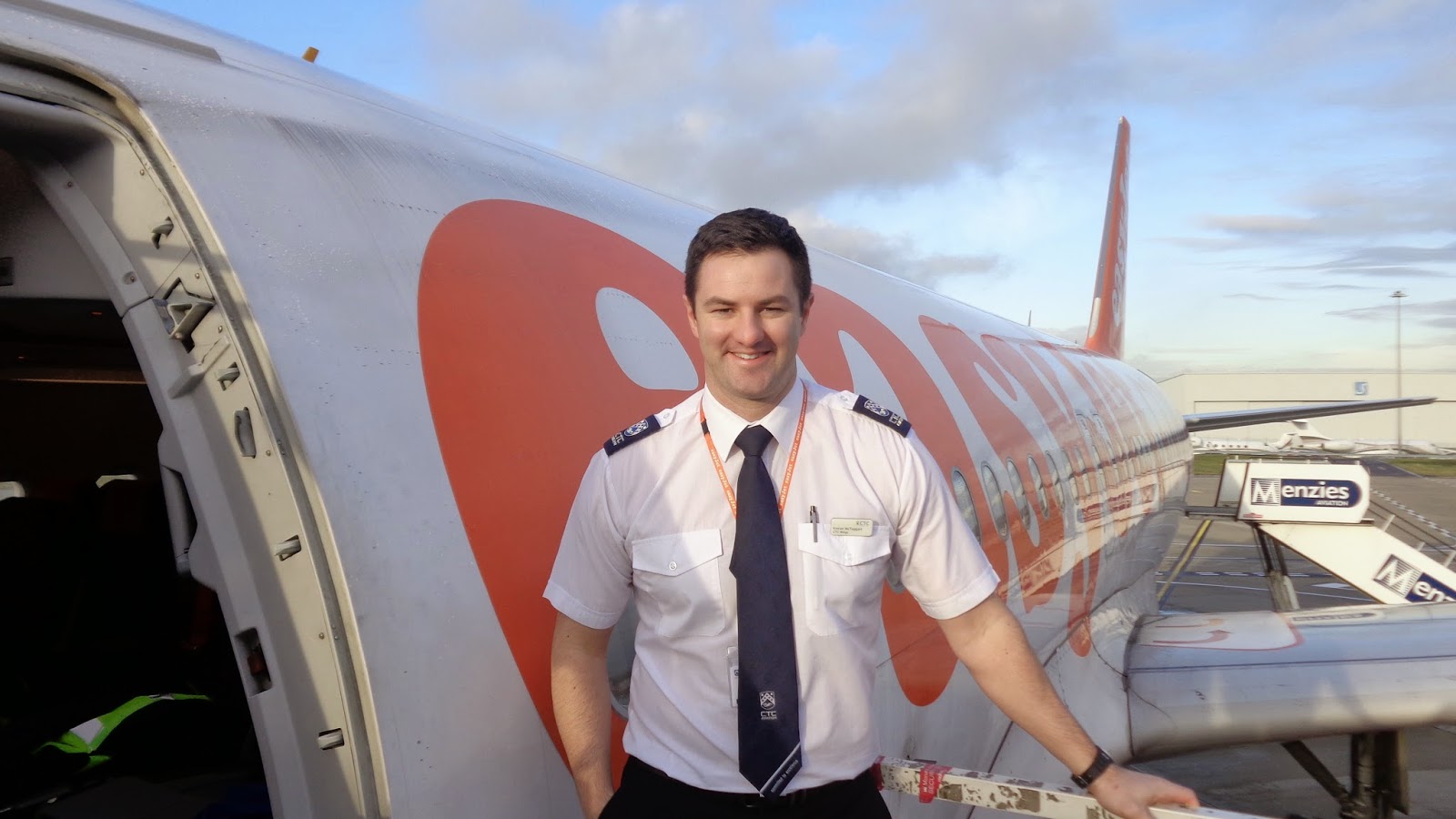
On board the childishness continued, as making announcements on the PA seemed a great idea, as did hanging out of the cockpit windows for photos. As much as this may seem immature, getting close to where we'll spend the rest of our careers is very excited, but the next time we're on an A319 the fear of base training will be taking away all the initial excitement! The day finished with a visit to easyJet ops back at H89, where we were talked through some of the stuff that keeps the airline running, but is rarely seen. This included flight planning and engineering, and I even met someone that used to be on the popular ITV programme 'Airline'.

As we had been put up in a hotel for the night, easyJet then took us out for dinner in town, so we had the opportunity to ask questions in a more relaxed environment over a few beers. This may not seem particularly significant, but given we are yet to make a single penny for the company and they've spent a few hundred pounds on our visit, it's nice to see that they value us enough to make an investment!

Day two was a slightly different set-up, as we were spoken to by two chaps from H89 concerning the business itself. The intention wasn't that we could subsequently do their jobs, but everyone found the presentations most informative and educational. This included looking at how ticket prices change, how difficult managing schedules can be, and how the company wants to grow. I left with a feeling that in 15 weeks i'm joining what is a very exciting and forward thinking company, but most importantly very stable. Also given the plan for expansion by 2019 there could be as many 316 in the fleet (about 100 increase), the scope for a short stint in the right hand seat before getting command is very promising. 


Anyway, enough rambling, apologies for all the nasty words. As usual any questions fire away, and here's some nice pics to look at!

Sunday, 23 November 2014

Week 61: finally my blog title makes sense!

Following more days in the classroom for our CRM training, we were back in the simulator looking at automation and the flight director. Automation is an invaluable tool on the flight deck of a commercial aircraft for a number of reasons:-
  • Accuracy- the computers will make the aircraft fly with a much higher degree of accuracy than a human.
  • Capacity- If a human is flying the aircraft, no matter how good they are some of their mental processing capacity is used for manual control. By freeing some of this up, the brain can plan and manage the flight more effectively.
  • Fatigue- even with the lightest of inputs required, human muscles would tire if expected to maintain control for long sectors, especially in circumstances of turbulence. The result of physical fatigue can be mental fatigue, at which point mental processing rapidly deteriorates.
  • High altitude control- a bit complex but at higher altitudes where the air is much thinner, the aircraft is constantly sitting on the fence with regards to stability (known as coffin corner). Inputs from a human at these altitudes would likely be too severe with a resultant control issue, so the computer uses much finer inputs to give the aircraft just enough control.
  • Cost- by being more accurate the autopilot will make the aircraft more efficient, and with efficiency comes a cost saving. Obviously with the operating costs sky-rocketing, anywhere money can be saved helps, so most company's encourage the use of automation whenever possible.
For the moment we've looked at automation in very simple terms, where we can tell it to fly a direction, level, and speed, but none of the flight management functions are engaged. Even though the automatics eventually lower our workload, as it's very new and we have to be comfortable with what modes are engaged, our brains are having to work harder than with manual flight. Thankfully as we become more used to the equipment mental capacity is freed up, and we're becoming better able to 'manage' the flight. Management tasks now include:-
  • Talking to the cabin crew- ensuring the cabin is secure, discussing any failures, changes of plan, diversions etc.
  • Negotiating with ATC- points of descent, radar vectors, procedures, emergencies etc.
  • Communicating with the cabin- the dreaded PA announcements! Passengers are afterall the customer, so PA's have to be informative, concise, as well as reassuring.
With the automation an awesome system called the flight director has been brought into play. For those of you that have gone through pilot aptitude, it's basically the crosshairs test where a vertical line and a horizontal line give indication of which direction you need to move the aircraft to achieve the desired flight path. The rather blurry image on the right is of the primary flight display (PFD) on the airbus, the flight director bars being the two green ones on the artificial horizon. It's not a great picture because there's a bit of confusion, but they are saying the pilot needs to pitch the nose up, and roll the wings to the left. When the horizontal bar lines up with the black dot the pilot needs to stop pitching, and when the vertical line moves so that it goes through the dot the aircraft is in the correct angle of bank. I've made that sound very complicated, but I promise that with practice they're a great tool.

Tomorrow I start flying LOFT routes (line orientated flight training) where we fly a sortie that should mimic a real flight with the airline, in real time. For my first one I will be departing on a shuttle flight from Heathrow to Prestwick, so from a dark aircraft in west London to parking in Scotland i'm in the driving seat, responsible for the progress of the flight and all that goes with that.

In company related news, easyJet have this week posted a profit of £581million before tax! This is obviously quite a substantial amount of money to be pouring into the bank account, and perhaps in years to come if the trend continues those joining cadetships might find the airline investing a lot more in their cadets so funding becomes less of a barrier. It's too late for me, but at least i'm off to a financially healthy company. Enjoy the last week of November, and for those of you that enjoy a bit of panic it's four weeks to Christmas!

Sunday, 16 November 2014

Week 60: Single engine ops, a cheeky spa break, and CRM.

In keeping with the theme of upset recovery and unusual situations in flight, this week we looked at single engine flight, including engine failures on take off and subsequent asymmetric flight. The main challenge of single engine operations is that in normal flight the thrust from each engine balances the aircraft, but when one engine loses thrust the forces are out of balance and there is a resulting force in the yawing plane (apologies for my crude picture!). This means the nose quickly steers towards the 'dead' engine, and the pilot must swiftly use rudder to maintain directional control. This has to be performed smoothly and without heavy inputs, as the rudder is very powerful and if applied too quickly could rip itself clear of the fin! Once the rudder is in the correct position to keep the aircraft going in the correct direction, trim is used to reduce the load on the poor pilots leg, otherwise they wont be able to fly for long. Performance of the aircraft drastically reduces as one engine is trying to do the work of two, and speed control is hugely important; if the speed is allowed to decay the amount of power required to recover could be massive, and with changes in power the directional control becomes more difficult, making the pilots life more difficult in an already undesirable situation. 

In terms of the exercises we looked at failures before rotation (when the nosewheel leaves the runway on take off), after rotation, and also at a stage early enough for the pilot to reject the take off altogether and stop. The obvious challenge is keeping the aircraft straight, as the time taken to wander towards the grass is quite short, and if a wheel leaves the paved surface chances are the situation will get a whole lot worse. Once the aircraft seems to be going the right direction, with one engine the nose is pitched up slightly slower than normal, and to a lesser angle. The cockpit workload is high, as the pilot flying is trying to maintain control of the aircraft, whilst the pilot monitoring (ensuring he remembers to call that the aircraft is climbing so the gear can be raised) is scans the instruments to ensure the climb out is safe, as well as doing an initial diagnosis of the situation. It can be an exciting time but to anyone it's clear just how safety critical the entire manoeuvre is. As for the rejected take off, this is the time when the aircraft's autobrake system really comes into its own, and to say it feels like someone has thrown an anchor out the back is an understatement!

View from the First Officers seat, with the infamous side-stick poised for action.

This week was also my birthday (29, getting old!), and my wonderful girlfriend took me to a rather swanky hotel for the night where I was treated to a massage and a facial. Yes I know I lose all credibility with a facial, but recently my face has looked like it's been shaved with broken glass, so anything that's going to stop the stinging is fine by me! Laying by the pool and slobbing about in the spa was also most welcome, even if I did get dirty looks for being childish with the foam noodles.........seemed a great idea to tie them in knots so I had armbands. Later I was surprised again with my course-mates surprising me in town for dinner, and after a brilliant dinner our friend had made an absolute stunner of a birthday cake, topped with my favourite marshmallows! Lucky boy I am :-)

All good things must come to an end, and yesterday we were back in the classroom for Crew Resource Management (CRM). This subject comes under the category of non-technical skills, an area that the aviation industry takes an incredibly keen interest in, as a break-down of 'notechs' has caused a significant amount of incidents. Even though we have been operating the airbus as a single pilot, we shortly will be more multi-crew orientated, and therefore workload management, communication, leadership, and situational awareness have been reviewed to ensure we have the tools to operate efficiently. 

In addition we have started to think about a large chunk of the aircraft's load which up to now haven't even been considered; the passengers. They are the customers and have a right to be kept informed, and for most of you the sound of the pilots voice on the public address system is a familiar part of the flight experience. As simple as it may seem, the PA is an incredibly powerful tool and of vital importance in ensuring a safe operation, but it is also very easy to make a mess of, use the wrong words, or leave the passengers even more confused. Accordingly we've been given this simple booklet with a few do's/don't's, and ideas on what to include in the announcements with guidance on the words/phrases to use. Thankfully we shouldn't be making any PA's for real for quite a while, but actually having to think about the wider operation shows how much closer the end really is! 

Sunday, 9 November 2014

Week 59: Full motion, upset, and a careers day.

As part of the upset recovery training I had two flights with full motion this week, the first in the Boeing 737-800 (the type used by Ryanair) and the second in the Airbus A320 which I am more used to. During the first we went through the upset recovery elements, then had a look at single engine flight and how the workload quickly ramps up for the pilot flying. This led us nicely onto an instrument approach at Edinburgh, where Matt had the chance to perform his first landing with the motion on. It was a fairly firm touchdown but at least he touched down! On my attempt, even though the touchdown was smooth, this was following a long 'float' down the runway, where I only touched down with about half the runway remaining. To say I was getting uncomfortable as the red lights of the runway end approached would be an understatement, and stopping with about 100m to spare wasn't the best!

Things for all three of us improved in the Airbus, and following more upset in both Normal and Alternate law, we had the chance to perform an instrument approach to Gatwick. Whatever I did, or however much luck was involved both my landing's were really smooth, so i'm a bit happier as I hadn't had much practice actually landing and it felt good to 'grease' it on. I'm putting both down to beginners luck, but we won't know until the motion goes back on in January.

The only other news was CTC Aviation's open day at Nursling which myself and my housemates volunteered our Saturday for. The most exciting and notable part of the day was the attendance of the Virgin Atlantic pilot management team, who were publicising the recent opening of the Future Flyers programme. Unfortunately the weather yesterday was awful, and the subsequent traffic on the motorways caused about a third of guests to be delayed or unable to attend. On the upside this meant there were periods where the sims were empty, so I got to have a few plays in more challenging conditions. This included a bit of fun in Geneva, where an instrument rating instructor from Bournemouth and I had a race to see who could fly the quickest circuit in the Airbus.....which i'm proud to say I won with a time just over 4 minutes! 

This afternoon i'm flying with a new instructor, and we're also looking at single engine flight and procedures in the A320. As much as we'd had a go in the 737, we were simply shutting the engine down and concentrating on the manual control, whereas now we'll learn and practice the procedures we will use as working pilots. Enjoy the week. 

Monday, 3 November 2014

Week 58: A trip to the darkside.

Although the MPL has been around for a number of years, the powers that be who decide what the course needs to contain sometimes can be a little slow to accept that technology moves on, and so training should reflect this. Because of this, even though our course is designed so that we reach a high level of competence in the Airbus, we are still required to spend a couple of sessions operating in a 'conventional jet', so last night my group had our introduction to the Boeing 737-700. 

So the conventional jet......when we look at the Airbus, it is an incredibly clever aircraft which operates with a huge amount of input from computers, utilising what is known as a fly-by-wire system. In a conventional aircraft there are more direct control paths between the pilot and the control surfaces, so if the pilot pulls the yoke back the elevator will stay up (which in turn pitches the nose up), with no reference to the aircrafts flight envelope (it's safe parameters). However in the Airbus movement of the controls doesn't cause a linear movement of the surface; simply put instead you are telling the aircraft that you are making a pitch/roll/yaw demand, and the computer will calculate how much movement is required for the input demand. 

What the hell is this thing for? Where does the tray go?!

The beauty (or curse) of the fly-by-wire system is that you are effectively telling the aircraft how you want it to fly through space, and once you have put it in that position (eg. nose 5 degrees up and rolling 20 degrees to the left), it will automatically trim itself to remain in this position until the next demand is requested. On the Boeing there are none of these niceties in manual flight, and with underslung engines, giving a handful of power will cause a pitch up (due to the pitch/power couple), so the aircraft felt a lot more twitchy. Obviously with practice and familiarity the pilot becomes more used to the handling characteristics of the Boeing, but I can say at present I am very much an Airbus man! I have a full motion session in the Boeing 737-800 this afternoon to put that to the test, but i'm fairly sure my love is for the Eurobus!

Asides from the flying an aircraft that responds differently, the cockpit layout was a little tough to get my head around when compared to the Airbus. This is chiefly because the 737 was designed in the mid-1900's and as it's design has changed and equipment had come and gone, controls have been put in where there was space. In comparison, the Airbus was designed from scratch in the 80's, and from day one was planned to be a more simplistic flight deck, and personally this suits me better.